Fyndr
If dating apps solved matching, why is hiring still a job board?
Self-initiated concept
The problem
Professional networking has two broken ends. Job boards match on keywords, so both sides waste weeks. Networking apps match on nothing, so a connection carries no information about whether the other person is real or relevant.
The solution
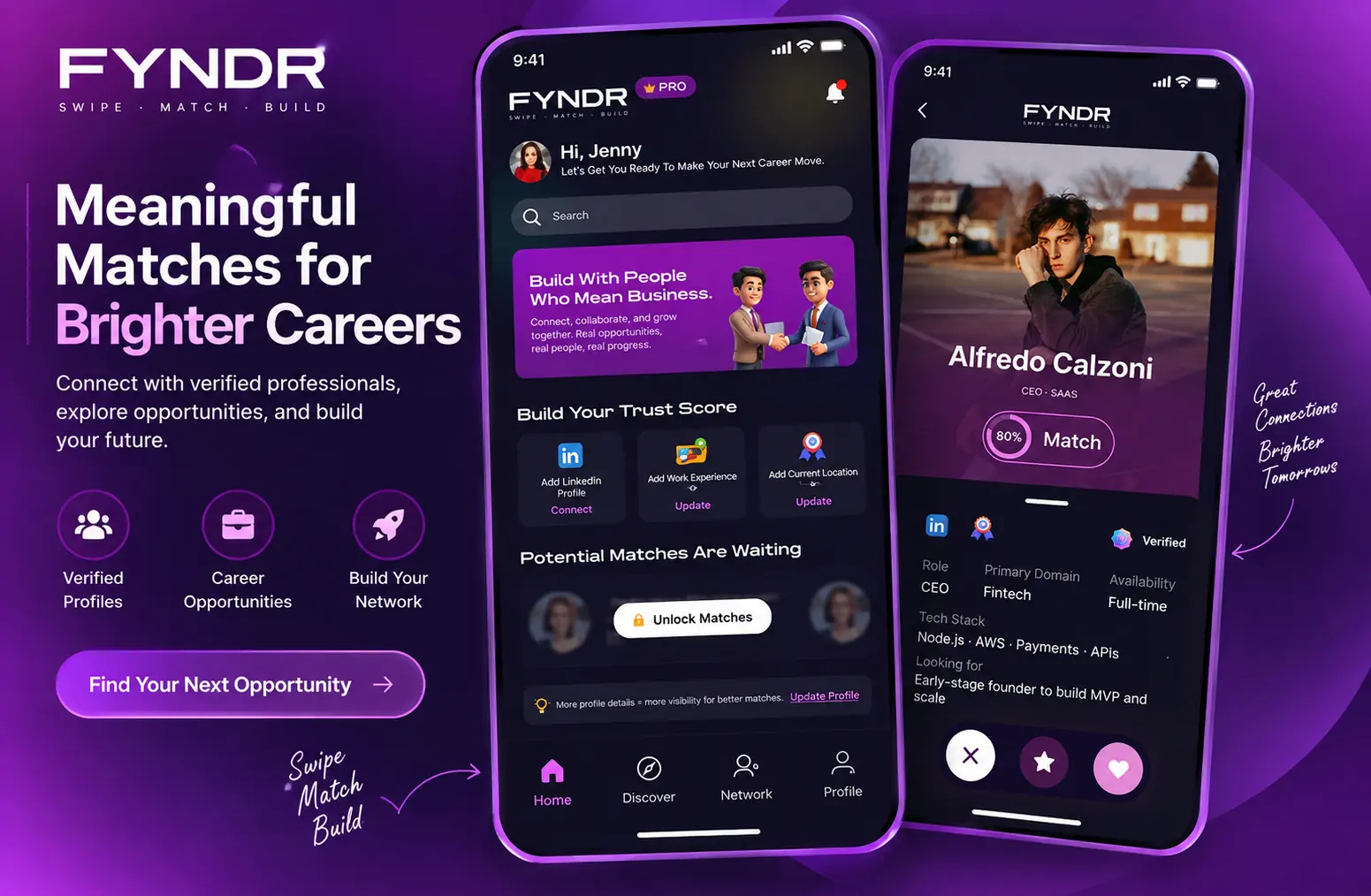
Trust as a first-class, visible object. The profile is scored on things that can be checked — a linked LinkedIn, verified work history, confirmed location — and the score is shown as a percentage match on the card itself, alongside role, domain, availability, tech stack and what the person is actually looking for.
The result
A concept explored end to end: onboarding, trust-score building, discovery, match and profile detail. Self-initiated design work, not a client engagement.
01
Overview
Fyndr is a self-initiated concept for professional networking built as a matching problem rather than a search problem: verified profiles, a trust score, and a swipe interface that surfaces people worth talking to.
02
Context
This is design work I started for myself, to think through a product category properly rather than to fill a brief. Nothing here was built for a client, and nothing here is claimed as shipped.
03
Challenge
The swipe pattern carries baggage. Applied naively to professional life it reads as unserious, and it collapses a career decision into a gesture. The interaction had to be borrowed for its speed while the content stayed unambiguously professional.
04
Approach
Every element on the card is a professional signal: role, primary domain, availability, tech stack, and — the one that does the most work — what the person is looking for, stated in their own words. The trust score is built visibly, through a checklist the user completes, so the number means something to the person being shown it. The dark treatment keeps the emphasis on the profile rather than the chrome.
05
What I did
- 01Product concept and proposition
- 02UX flows: onboarding, trust-score building, discovery, match, profile detail
- 03Interface design across the concept's core screens
- 04A visual system and identity for the concept
- 05Presentation design for the concept itself
Concept
Not shipped.
Worth showing.
This is self-initiated design work rather than a client engagement — a product category taken apart properly, end to end, because it was worth understanding. If it is close to something you are building, that is a good conversation to have.
Next project
Eleva